
Introduction to Aptos
Aptos has undeniably captured the spotlight, drawing the interest of prominent venture capitalists and the broader cryptocurrency community. The potential for groundbreaking innovation within the Aptos blockchain is undeniable, but its practical success in overtaking competitors remains to be seen. As with any investment, time holds the key to revealing the true potential of this blockchain. Investors considering Aptos should approach it with meticulous due diligence and a well-thought-out contingency plan to navigate the ever-evolving landscape of blockchain technology.
Project Overview of Aptos
Aptos, with its unique vision and innovative approach, is poised to revolutionize the blockchain landscape. In this article, we will take a closer look at what makes Aptos stand out among the crowd.
At the heart of Aptos lies a blockchain that forms the backbone of its operations. But what makes this blockchain special? Aptos employs a proof-of-stake (PoS) consensus mechanism, which sets it apart from its predecessors in the crypto world. PoS, as opposed to the energy-intensive proof-of-work (PoW) used by Bitcoin, offers a more sustainable and efficient way to validate transactions and secure the network.
This PoS protocol not only reduces the environmental footprint of Aptos but also enhances its scalability. Transactions on the Aptos blockchain are processed swiftly and at a fraction of the energy cost associated with PoW chains. This scalability is a game-changer, as it allows Aptos to handle a high volume of transactions, making it a viable option for a wide range of applications, from peer-to-peer payments to complex smart contracts.
Aptos is not content with just being a standalone blockchain. It has its sights set on interoperability, aiming to seamlessly connect with other blockchains and networks. To achieve this, Aptos incorporates innovative protocols that facilitate cross-chain communication. This interoperability opens up a world of possibilities, enabling data and assets to move freely between different blockchain ecosystems.
Moreover, Aptos boasts a sophisticated smart contract platform. Smart contracts are self-executing agreements with the terms of the contract directly written into code. They automate complex processes, enabling trustless transactions and decentralized applications (dApps) to flourish on the Aptos network. With the ability to create and deploy smart contracts, developers have the tools they need to bring their decentralized visions to life.

Aptos Project Background
Mo Shaikh, the co-founder and CEO of Aptos Labs, brought a wealth of experience to the table. Prior to his journey with Aptos, Mo played a pivotal role in Meta, where he spearheaded strategic partnerships. His foray into the crypto space was marked by the founding and leadership of Meridio, a blockchain-based investment platform. Furthermore, his stint as the Director of Strategy at ConsenSys from 2017 to 2020 showcased his deep understanding of blockchain technology and its potential impact.
On the other side of this dynamic duo, Avery Ching, co-founder and CTO of Aptos Labs, emerged as a technical virtuoso. Avery spent an impressive decade as a chief software engineer at Meta (formerly Facebook). During his tenure there, he led the charge as the Tech Lead for both the Novi crypto platform and the Diem blockchain. Avery’s expertise and innovative spirit have been instrumental in shaping the technical prowess of Aptos.
The Aptos team, extending beyond its founders, is a diverse and accomplished assembly of engineers, researchers, strategists, designers, and builders. Their shared commitment revolves around the ambitious mission of providing universal and equitable access to decentralization, with the scalability to cater to billions of people.
In the whirlwind journey of Aptos, financial milestones and strategic investments have played a pivotal role in shaping its path. The story unfolds with a resounding success in March 2022, as Aptos secured a substantial $200 million in a seed round, spearheaded by the esteemed venture capital firm Andreessen Horowitz (a16z). Notably, heavyweights of the crypto realm, including Tiger Global and Multicoin Capital, joined forces in this funding endeavor. Fast forward to July, and Aptos continued its upward trajectory by raising an additional $150 million in a Series A round, with key leadership coming from Sam Bankman-Fried’s FTX Ventures and Jump Crypto.
However, the narrative took a significant twist when the renowned Binance Labs strategically invested in Aptos merely two months later, solidifying its presence with an undisclosed amount. This strategic move elevated Aptos’ valuation to a remarkable $4 billion by September. The culmination of this remarkable journey occurred on October 18, 2022, when Aptos proudly announced its mainnet launch, marking a pivotal moment in its evolution. Notably, the Aptos genesis had taken place just six days earlier on October 12, 2022, further adding to the chronicle of this remarkable cryptocurrency project.
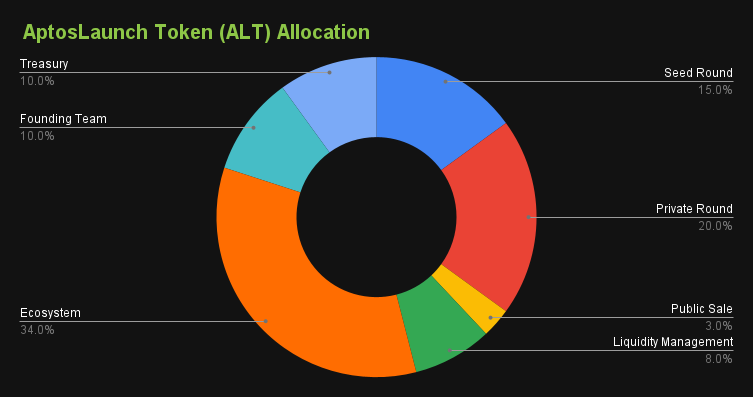
Tokenomics
At the heart of the Aptos ecosystem lies its native utility token, APT. This digital asset is the lifeblood of the network, serving a multitude of functions that extend far beyond a mere medium of exchange.
Understanding the supply dynamics of APT is essential for grasping its potential value. Aptos employs a unique approach where token distribution occurs over time, fostering a sustainable ecosystem. With its deflationary design, APT’s total supply gradually decreases, making each token more valuable. As the platform gains adoption, APT’s utility and scarcity are likely to drive demand and, consequently, its price.
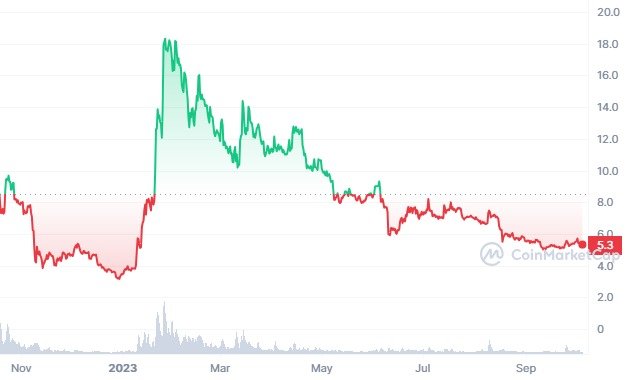
Market Cap: $1,053,732,640.15
Circulating Supply: 130,000,000
Supply Cap: 1,000,000,000
All Time High: $10.25(October 23, 2022 -20.89%)
All Time Low: $6.69(October 19, 2022 21.20%)
Here’s a closer look at the key attributes of APT:
1. Utility and Governance: APT is not just a means of transferring value but also plays a pivotal role in governing the Aptos network. Token holders have the power to influence decisions and protocols through a decentralized governance model, where the more APT you hold, the more say you have in shaping the platform’s future.
2. Staking Rewards: Aptos embraces the concept of staking, allowing users to lock up their APT tokens in return for lucrative rewards. Stakers provide security to the network and, in turn, receive a portion of transaction fees, adding an attractive passive income avenue for APT holders.
3. Incentives for Validators: Validators, the backbone of the Aptos network, are rewarded with APT tokens for their efforts in validating transactions and maintaining network integrity. This ensures a robust and secure ecosystem that benefits all participants.
4. Deflationary Mechanism: Aptos incorporates a deflationary mechanism, meaning that over time, the supply of APT is designed to decrease. This scarcity factor can potentially drive up the token’s value, offering an intriguing proposition for investors.
5. Ecosystem Integration: APT serves as the bridge between the Aptos blockchain and the real world. It facilitates seamless integration with external systems, opening doors to a wide array of real-world applications.
Features and Functionality of Aptos
-
Scalable and Sustainable: Aptos is designed to scale efficiently as adoption grows. Its architecture can handle a high volume of transactions, ensuring that the network remains fast and responsive even during periods of intense activity. This scalability is crucial for supporting a wide range of real-world applications.
-
Delegated Proof-of-Stake (DPoS): Aptos employs a DPoS consensus mechanism, which enhances network security and decentralization. DPoS allows token holders to vote for block producers, who are responsible for validating transactions. This system ensures that those with a stake in the network have a say in its governance.
-
Cross-Chain Compatibility: One of Aptos’ standout features is its ability to bridge different blockchain networks. This cross-chain compatibility opens up a world of possibilities, allowing Aptos to interact with various cryptocurrencies and decentralized applications seamlessly.
-
Smart Contracts: Smart contracts are the backbone of many blockchain ecosystems, and Aptos is no exception. It supports these self-executing contracts, enabling developers to create a wide range of decentralized applications (dApps) and automated processes.
-
Governance Model: Aptos is committed to decentralization, and its governance model reflects this commitment. Token holders have the power to influence network decisions, making it a truly community-driven platform.
-
Staking Rewards: APT holders can participate in the network’s staking mechanism, where they lock up their tokens to support network security and, in return, earn rewards. This incentivizes participation and provides a way for token holders to earn passive income.
-
Interoperability: Aptos isn’t confined to its own ecosystem; it’s built with interoperability in mind. This means it can seamlessly interact with other blockchain networks and external systems, expanding its potential use cases.
-
Deflationary Design: APT incorporates a deflationary mechanism, meaning its total supply gradually decreases over time. This scarcity can potentially drive up the token’s value, making it an appealing choice for investors.
-
Real-World Applications: Aptos aims to bridge the gap between blockchain technology and the real world. It can be used for a wide range of applications, from supply chain management to finance and beyond.
-
Community-Driven Development: The Aptos community plays a vital role in shaping the platform’s future. With a strong emphasis on open-source development and collaboration, it thrives on community contributions and feedback.
Use Cases of Aptos
-
Decentralized Finance (DeFi): DeFi is one of the most exciting sectors in the crypto space, and Aptos has a crucial role to play. It can facilitate decentralized lending, borrowing, and trading of assets, all without relying on traditional intermediaries like banks. This opens up financial services to a global audience, including those without access to traditional banking.
-
Gaming and Non-Fungible Tokens (NFTs): The gaming industry is increasingly embracing blockchain technology, and Aptos fits right in. It can power in-game economies, enable the creation of unique, tradable NFTs for in-game items, and provide players with true ownership of their digital assets.
-
Cross-Border Payments: Sending money across borders can be costly and time-consuming. Aptos can power cross-border payment systems, providing a more efficient and cost-effective solution for remittances and international transactions.
Advantages, Risks and Challenges
Advantages:
Interoperability: One of Aptos’ standout features is its compatibility with other blockchains. This interoperability opens doors for cross-chain collaboration, allowing users to access a wider range of assets and services.
Decentralized Finance (DeFi): Aptos plays a crucial role in the DeFi ecosystem. Its smart contract capabilities enable decentralized lending, borrowing, and trading, reducing reliance on traditional financial intermediaries.
Security and Transparency: The blockchain’s immutable ledger ensures data security, making it suitable for use cases like supply chain management and healthcare where data integrity is critical.
Fractional Ownership: Tokenization of real-world assets allows for fractional ownership, democratizing investment opportunities and increasing liquidity in traditionally illiquid markets.
Identity Solutions: Aptos can provide secure digital identity solutions, improving online security and simplifying identity verification processes.
Challenges:
Regulatory Uncertainty: The regulatory landscape for cryptocurrencies is continually evolving. Aptos’ success may be influenced by how regulators classify and treat it.
Competition: The blockchain space is crowded with innovative projects. Aptos faces competition from established players and emerging newcomers.
Scalability: Like many blockchain platforms, Aptos must address scalability concerns to handle a growing user base and transaction volume effectively.
Risks:
Market Volatility: Cryptocurrencies are known for their price volatility. Investors in Aptos should be prepared for rapid price fluctuations.
Security Vulnerabilities: Smart contracts, while powerful, can have vulnerabilities. Proper auditing and security measures are essential to mitigate risks.
Adoption Challenges: The success of any blockchain project relies on adoption. Convincing users and businesses to embrace Aptos is a significant challenge.
Technological Risks: Aptos, like all blockchain projects, faces risks related to software bugs, network upgrades, and consensus mechanisms.
Conclusion
Aptos cryptocurrency has the potential to bring significant benefits to various industries through its interoperability, DeFi capabilities, and security features. However, it must navigate regulatory challenges, fierce competition, and technological risks to achieve its goals. As with any investment, individuals considering Aptos should conduct thorough research, understand the associated risks, and approach it with a long-term perspective.