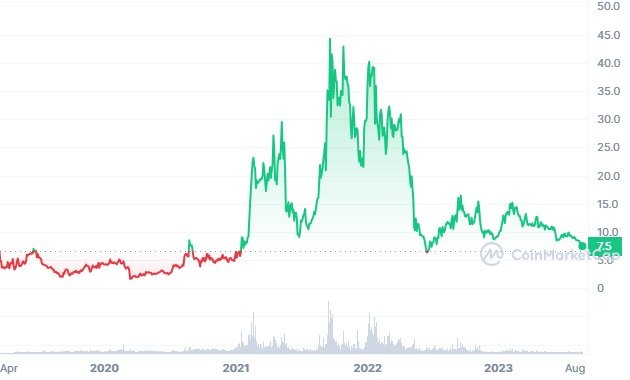
Cosmos Price Stats
Market Cap: $8,221,445,009
Circulating Supply: 292,304,426 ATOM
Supply Cap:
All Time High: $44.45 -36.5% Jan 17, 2022 (3 months)
All Time Low: $1.16 2333.8% Mar 13, 2020 (about 2 years)
Brief Description of Cosmos
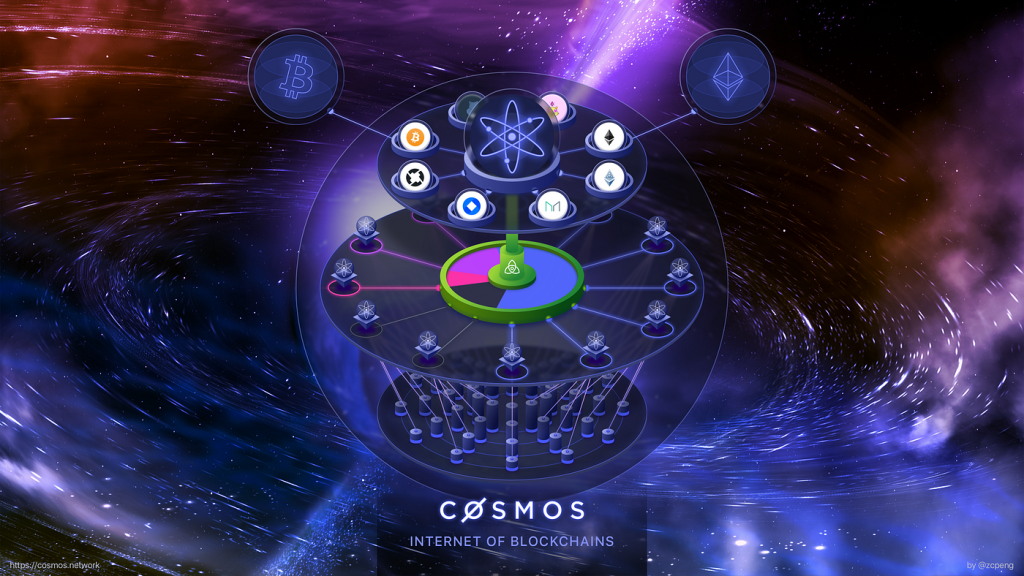
The Cosmos network presents an intricate web of independent parallel blockchains known as zones, each powered by classical Byzantine fault-tolerant (BFT) consensus protocols such as Tendermint. Functioning as hubs for other zones, certain zones facilitate interoperability, allowing multiple zones to collaborate through shared hubs. This architectural concept draws inspiration from Bitcoin’s sidechains but employs classic BFT and Proof-of-Stake mechanisms, offering enhanced scalability and interconnectivity. Cosmos distinguishes itself by its ability to seamlessly interact with various applications and cryptocurrencies, enabling the creation of new zones that effortlessly link different blockchain systems via the Cosmos hub, without intermediaries. Anchoring this system is the native token, atom, which serves as a spam prevention mechanism, staking collateral, and a governance voting tool.
Launched by Tendermint Inc. in 2017, although conceptualized since 2014, Cosmos aims to resolve the fundamental challenges of blockchain, including scalability, intricate dApp development, and limited blockchain interoperability. Its vision of creating the “Internet of Blockchains” has materialized into a vast ecosystem of interconnected blockchains, offering unprecedented scalability, interoperability, and customization. The Cosmos ecosystem, anchored by the ATOM token, has gained significant traction in the DeFi space, with tokens trading at $35.90, reflecting a remarkable rally driven by increasing DeFi interest. The ecosystem boasts more than 250 apps with over $150 billion in assets, encompassing notable platforms like Multiverse, Crypto.com, Qredo, and LightStreams. This surge is a response to the surging value locked in the DeFi sector, exceeding $177 billion, as reflected by DeFi Llama data. Prominent DeFi platforms within the Cosmos Hub, including Gravity DEX, Osmosis, Sifchain, and Coinswap, have observed a surge in total value locked. With availability on major exchanges like Binance, Coinbase, and OKEx, Cosmos continues to draw attention in the ever-evolving crypto landscape.

The Team Behind Cosmos
Tendermint, the gateway to the expansive Cosmos ecosystem, was co-founded by a trio of visionaries: Jae Kwon, Zarko Milosevic, and Ethan Buchman. While Jae Kwon remains the principal architect, he relinquished his CEO role in 2020, affirming his ongoing involvement in the project while dedicating more attention to other ventures. Taking the reins as Tendermint’s CEO is now Peng Zhong, accompanied by a substantial overhaul of the entire board of directors. Their collective ambitions encompass elevating the developer experience, fostering an engaged Cosmos community, and disseminating educational resources to illuminate the network’s remarkable potential to a wider audience.
Advantages of Cosmos
- Decentralized Integrity: A key advantage of the Cosmos network lies in its decentralized nature. Without a single point of control, the network is inherently resistant to manipulation or corruption, fostering a secure and tamper-proof environment for transactions and data.
- Interconnected Blockchain Ecosystem: Cosmos excels in enabling various blockchains to seamlessly communicate and share information. This interconnectedness fosters a rich ecosystem where different blockchain platforms can collaborate, promoting innovation and diverse use cases.
- Scalable Transactions: The architecture of Cosmos is designed to handle a vast number of transactions concurrently, outperforming many other blockchain systems. This scalability enhances its utility in real-world applications and paves the way for widespread adoption.
- Minimized Transaction Costs: By negating the need for miners to validate transactions, Cosmos reduces the energy consumption and overhead costs associated with traditional blockchain networks. This approach contributes to a more environmentally friendly and cost-efficient system.
- Empowering Developers: Cosmos offers a developer-friendly environment with an array of tools and resources. This empowers developers to create robust decentralized applications (DApps) with greater ease, contributing to the growth and diversity of the Cosmos ecosystem.
- Enhanced Interoperability: Cosmos stands out for its focus on interoperability, enabling different blockchains to exchange information seamlessly. This capability opens up opportunities for cross-chain applications and collaborations, enriching the overall blockchain landscape.
Disadvantages of Cosmos
- Complex Implementation: One challenge associated with the Cosmos network is its complexity. The interplay between various interconnected blockchains and the technical intricacies involved in ensuring seamless communication can create a steeper learning curve for developers and users compared to simpler blockchain systems.
- Dependence on Hub: While Cosmos’s architecture enables diverse blockchains to interoperate, this dependency on a central hub for communication could potentially lead to a single point of failure. If the hub encounters technical issues or is compromised, it could disrupt the entire network’s functionality.
- Governance Challenges: The decentralized governance model of Cosmos, while innovative, can also lead to challenges in decision-making. Disagreements among stakeholders could result in delays in implementing upgrades or changes to the network, potentially impacting its agility and evolution.
- Limited Adoption: Despite its promising features, Cosmos still faces competition from established blockchain networks. Achieving widespread adoption requires not only technical prowess but also overcoming network effects and persuading developers and users to migrate to the Cosmos ecosystem.
Use Cases of Cosmos
- Cross-Chain DeFi Platforms: Cosmos offers an ideal ecosystem for the creation of cross-chain decentralized finance (DeFi) platforms. By enabling various blockchains to seamlessly interact, Cosmos fosters a robust DeFi landscape where assets from different chains can be utilized for lending, borrowing, and trading, expanding the scope and accessibility of decentralized financial services.
- Cross-Border Payments: The ability of Cosmos to facilitate interoperability between different payment systems and cryptocurrencies positions it as a potential solution for cross-border payments. By connecting disparate financial systems, Cosmos could streamline cross-border transactions, reducing costs and delays associated with traditional remittance methods.
- IoT and Data Exchange: The interconnectivity provided by Cosmos has applications beyond finance, including the Internet of Things (IoT) and data exchange. Devices from different IoT networks can communicate through Cosmos, creating an environment where data from diverse sources can be securely shared, analyzed, and monetized.
- Tokenization of Real Assets: Cosmos’s cross-chain capabilities could revolutionize the tokenization of real-world assets. Different aspects of an asset, such as ownership rights, usage rights, and provenance, can be recorded on separate blockchains and synchronized through Cosmos, making real asset tokenization more transparent, accessible, and secure.
- Gaming and Virtual Worlds: Cosmos’s potential for handling high transaction volumes and enabling interoperability between different game ecosystems makes it appealing for the gaming industry. In-game assets and currencies from various games can be exchanged and utilized across different gaming platforms, enhancing the cross-game experience for players.
- Blockchain-as-a-Service (BaaS): Cosmos’s ability to create customized blockchains and interconnected networks makes it suitable for enterprises seeking to harness blockchain technology without building an entire infrastructure from scratch. Enterprises can utilize Cosmos to develop tailored blockchains to suit their specific needs while benefiting from interconnectivity and security features.
Summary
The Cosmos network, a decentralized ecosystem, stands out for its interconnected blockchain architecture enabling seamless communication between diverse blockchains, thereby fostering innovation and utility. Its decentralized nature and high scalability offer a secure and efficient environment for applications ranging from decentralized finance (DeFi) platforms and supply chain management to cross-border payments and IoT data exchange. While Cosmos’s potential for enhancing various sectors is evident, it also faces challenges such as complex implementation and security concerns, demanding ongoing efforts to balance its advantages and limitations.