Azuki Responds to the Elementals Mint Debate
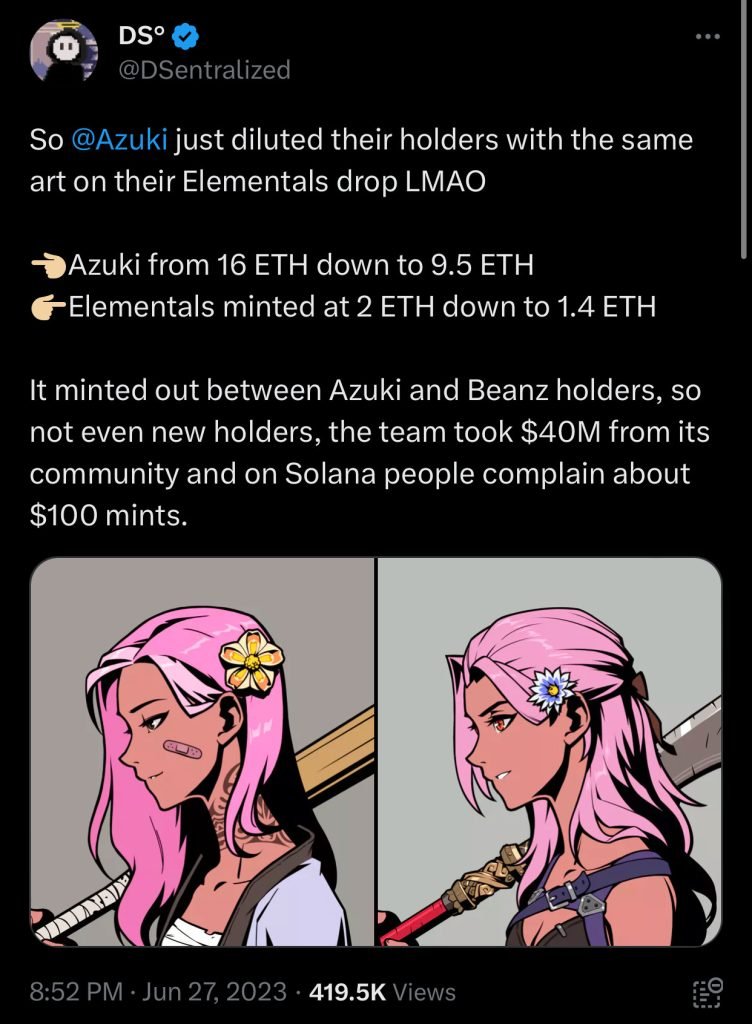
The Elementals minting event started as scheduled on June 27 at 12 p.m. ET. Owners of NFTs from the original Azuki collection were given access to the mint at this time. Then it would be time for owners of Beanz NFTs to mint at 12:10 PM ET. However, it appears that because Azuki did not set a limit on the number of Elementals that a single collector could mint, the sister collection’s entire supply was used up before the Beanz window even opened and well before the start of the public auction. While a variety of Azuki holders expressed satisfaction with the events surrounding the mint, many others expressed anger that despite arriving on time, they were unable to obtain an Elemental. A surprising 332 Elementals were even purchased by one person during the presale because to the lack of a cap on individual minting, which prevented many Beanz holders from minting.
However, the public’s reaction to the Elementals mint mechanics was just the beginning. Because when the artwork was made public, it was obvious that Elementals wasn’t living up to the hype. Notably, many people observed that the recently released collection shared an unacceptably high degree of striking similarities with the prior one.
There was a divide in the NFT community due to complaints that Azuki Elementals was too similar to the original collection. Many aficionados said that the Azuki supply had been reduced, while others started to hypothesize about the fundamental characteristics of the new NFTs and how, ultimately, the new collection would be beneficial for the Azuki name.
In their defense, Azuki wrote a thread addressing both those who oppose and favor its new collection. Azuki continued to elaborate in the thread on the lofty goals of Elementals, noting that the collection was intended to “welcome new members into the community” while also broadening the Azuki universe and permitting the creation of “a new type of anime that’s already under production.” The Azuki campaign ended on a positive note despite the brand’s admission of error, with the brand noting, “We know that we lost a piece of trust today, but nothing gets us more motivated to make things right.” Collectors were shocked when Azuki uploaded a picture of a green bean with a mysterious caption, possibly teasing the release of yet another surprise collection.
Although nothing is known about the “green bean,” given that beans have traditionally represented a drastic shift in the Azuki environment, it wouldn’t be far-fetched to speculate that something significant might be in the works. Airdrops, intricate “evolution” dynamics, and of course, yet another PFP collection have all been conjectured upon by collectors as plausible outcomes thus far.
‘HV-MTL Forge’ to Start in June, according to Yuga Labs
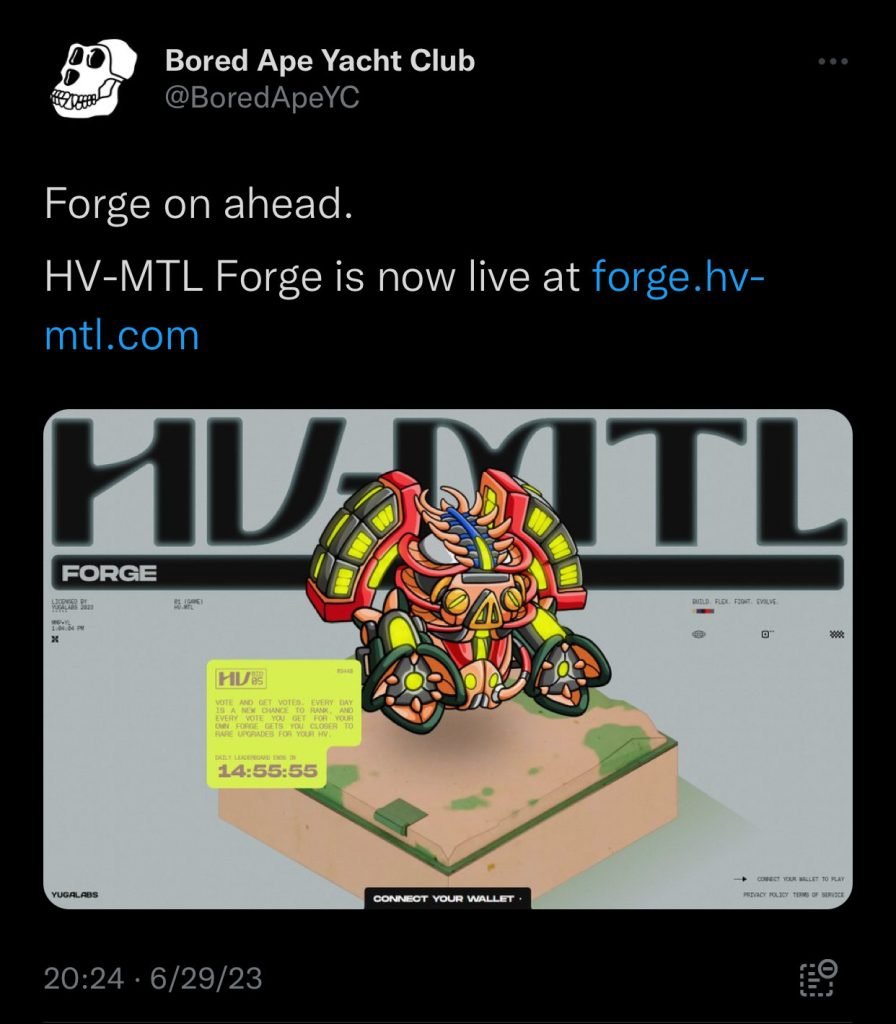
The first season of the HV-MTL Forge event will begin on June 29, as announced through Twitter. Users have been debating the usefulness of their Sewer Pass-earned NFTs for a while. It is now evident that HV-MTL will reside in a fully gamified metaverse of their own, comparable to Otherside and Kodas. The forge event will usher in a new era of gamified activities for the HV-MTL ecosystem.
Its tagline is “Build. Flex. Fight. Evolve.” Beginning at the end of June, owners of HV-MTL NFT cards will have the option to start creating in-game residences for their HV characters. After that, users will be able to “flex” their forges, creating a competitive, tier-ranked system where players can vote on and battle for votes to claim the top spot. Holders of HV-MTL can take use of the system to unlock enhancements and get ready for upcoming events in the game’s environment. Build and alter a workshop in HV-MTL Forge that gets your HVs ready for evolution. The official HV-MTL website states, “Show off your inventions to climb the scoreboard and unlock special abilities. Take chances and contend with the rift’s perils in order to find blueprints, gather resources, and make improvements. Collectors won’t be able to access all the exciting new HV-MTL features until closer to the forging event, in typical Yuga fashion. Users are undoubtedly in for a ride if the celebrations resemble an Otherside “trip”.
Dmitri Cherniak’s Ringers #879, ‘The Goose,’ Just Sold for $6.2 Million
Dmitri Cherniak, a Canadian artist and programmer, published Ringers, a collection of 1,000 generative NFTs, in January 2021. Each NFT in the collection was created using Javascript and deduced using a distinct transaction hash. They were made available on the well-known generative Web3 platform ArtBlocks for just 0.1 ETH each, and they were sold out in just 18 minutes. The idea behind Ringers is straightforward, and many people think that this is what makes it so beautiful. Cherniak was inspired by the work of Swiss graphic designer Armin Hoffman because he wanted to make art based on the idea of wrapping strings around pegs and was intrigued by the seemingly endless possibilities.
The difference in the amount of pegs, placement, peg size, colors, and wrap orientation led to thousands of visually appealing possibilities when an algorithm was applied. One of the reasons Ringers #879 is valued so highly is because of this. The improbability of an animal shape arising from the generating randomness contributes to its attraction, visual identity, and rarity in addition to being a pleasant and unexpected accident created indirectly from the imagination of the artist who devised the guiding algorithm. The Goose’s tale starts in New York, where a printed copy of the work was signed on July 29, 2021. TheCryptonite created Ringers #879 on January 31, 2021, and sold it to pixelpepe for 1.26 ETH four days later (he also received the actual print in addition to the NFT). On August 27, 2021, Three Arrows Capital, a now-defunct Singapore-based cryptocurrency hedge fund, paid 1,800 ETH ($5.9 million) to acquire it. Notably, VincentVanDough made an offer to purchase the work for 500 ETH, but it was rejected.

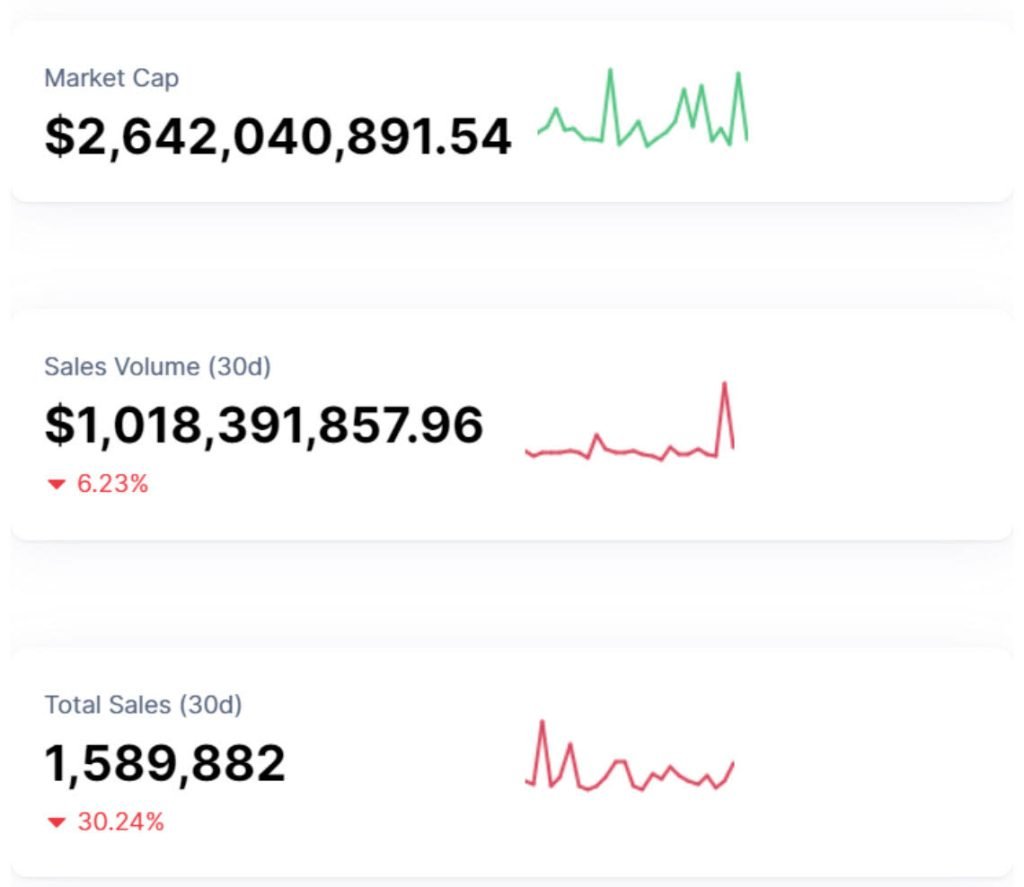
In June 2023, the overall market capitalization for NFTs experienced a slight drop as compared to the previous month of May. The market cap of NFTs in June was around $2.6M, a significant decrease from the previous value of $3.1M in May. However, there was an increase in the total number of NFT sales as well as volume from the previous month bringing an end to yet another ‘boring’ month in the NFT ecosystem.
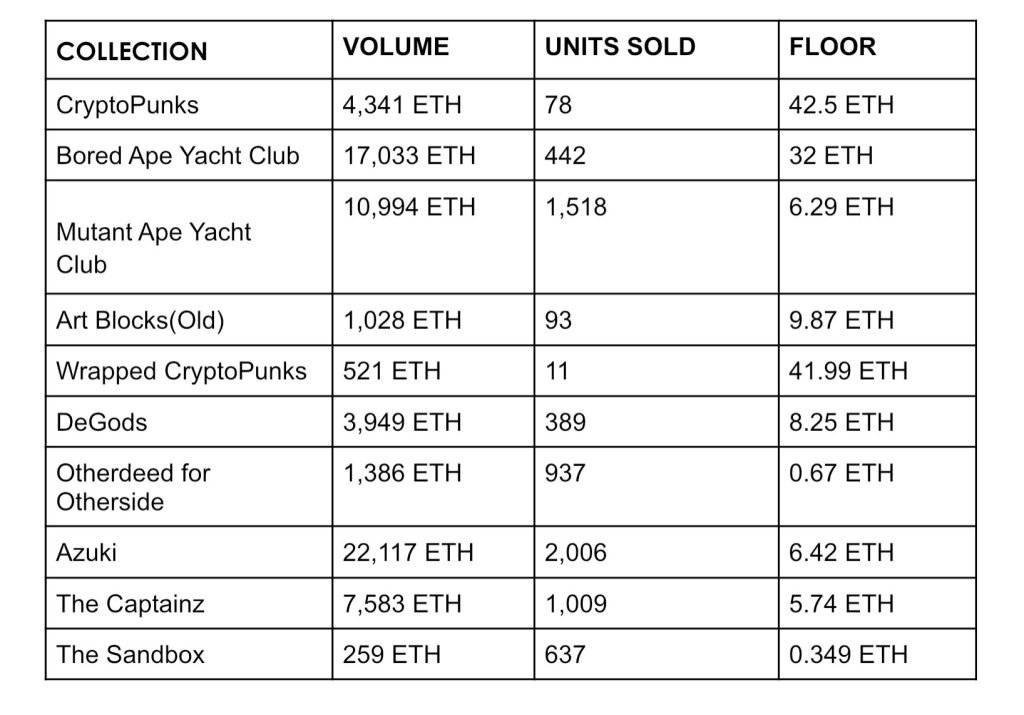
Top Bluechip NFTs
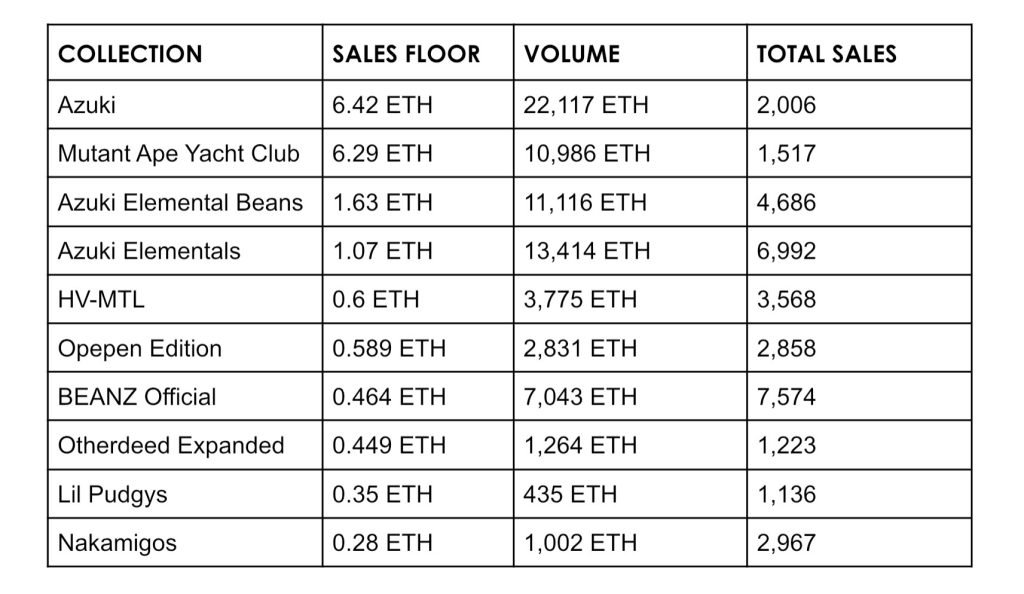
Trending NFT Collections by Sales Floor
Potential Upcoming Mints
(Ordinals/BRC-20)
- OnChain Monkeys- @OnChainMonkey
- Ordinnals Maxis- @OrdinalMaxiBiz
- Asprey Studio- @AspreyStudio
- Bitcoin Whales- @Bitcoin_Whales_
- The Ordinal- @TheOrdinal
- Ordillas- @Ordillasbtc
- Titan Meka- @Titan_Meka
(Ethereum)
- Today- @todaythegame
- Dimensionals- @DimensionalsRPG
- Overworld- @OverworldPlay
- Akogare- @AkogareOfficial
(Solana)
-
- @BoDoggosNFT
- @NekkroNFT
Summary
Like May, June was also relatively ‘quiet’ in the NFT scene. Most traders seemed content with sitting on their hands, rather than investing in the highly volatile market. While some think this might be the beginning of the end of NFTs, others believe this to be temporary and that “NFTs are here to stay”. The monthly statistics show that there was very little change from last month. June can be considered a stable month, NFT-wise. Avid traders are adopting a wait-and-see attitude to see if the bull market would bring back the highly anticipated NFT summer.