What are Zk Rollups
The term “zero-knowledge” in ZK-Rollups signifies the use of cryptographic proofs that verify transactions without disclosing any transaction details. These zero-knowledge proofs provide a vital layer of privacy and security, making ZK-Rollups an attractive option for users and developers alike.
At its core, a ZK-Rollup is a Layer-2 scaling solution designed to increase Ethereum’s throughput while reducing congestion on the mainnet. It achieves this through the strategic use of three primary components: a smart contract on Ethereum, a prover, and a group of verifiers.
The smart contract acts as the orchestrator, managing interactions between chains. The prover, typically a third-party entity, generates cryptographic proofs validating transactions on the Layer-2 chain. These proofs, compact and efficient, are submitted along with a minimal set of data to the Ethereum mainnet. Verifiers, a distributed group of nodes, then confirm the validity of these proofs and update the smart contract’s state accordingly.
The transaction process involves users signing transactions and submitting them to the prover. Periodically, the prover batches thousands of transactions, creating a zero-knowledge proof of their validity. This proof, which reveals no transaction details, undergoes rapid verification on the mainnet. Withdrawals are equally streamlined, with exit requests instantly unlocking and transferring funds, thanks to the efficient validation process.
Types of ZK Rollups
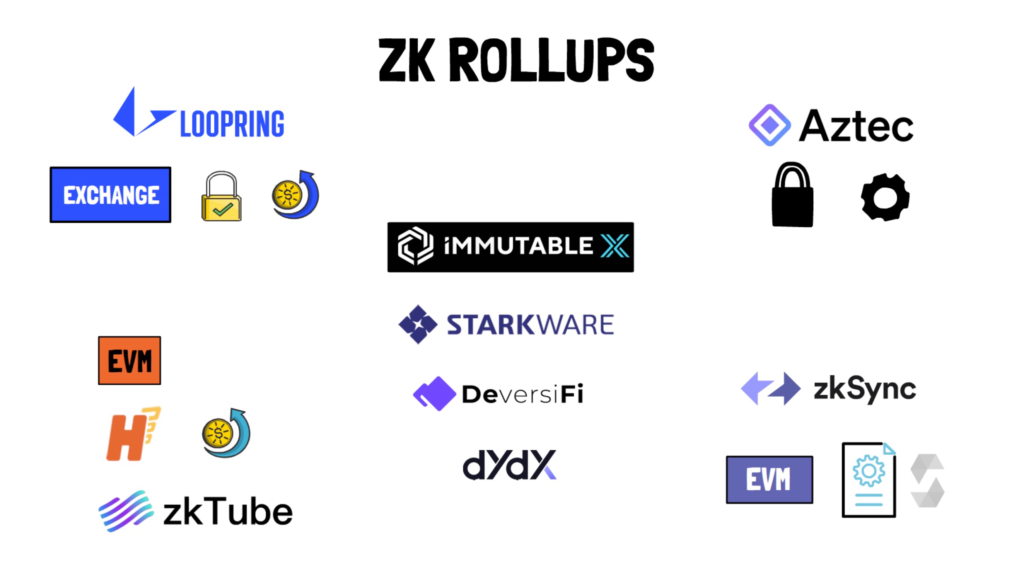
ZK-Rollups exhibit diversity in terms of proof systems, circuit designs, and data availability solutions, each impacting scalability, usability, and compatibility. Proof systems like zk-SNARKs, zk-STARKs, PLONK, and Bulletproofs bring their unique strengths to the table. Circuit designs, whether account-based, UTXO-based, or ZKVM-based, cater to various use cases. Meanwhile, data availability solutions offer different trade-offs, from decentralized storage networks to data availability committees and sampling mechanisms.
Advantages of Zk Rollups
-
Lower Gas Fees: By processing batches of transactions with minimal on-chain data, ZK-Rollups significantly reduce gas costs.
-
Higher Throughput: These solutions sidestep base layer limitations, enabling faster transaction speeds and reduced confirmation times, potentially increasing throughput by up to 100 times.
-
Faster Confirmation Times: Users no longer endure lengthy block confirmation times, receiving immediate feedback and finality on Layer-2 chains.
-
Privacy Features: ZK-Rollups bolster transaction privacy, revealing minimal on-chain data and concealing transaction amounts or recipients.
-
Security and Integrity: Benefitting from Ethereum’s robust consensus mechanism, ZK-Rollups offer users trustless and secure transaction processing.
Challenges and Limitations
-
Proof Generation Costs: The complexity of generating zero-knowledge proofs can result in high costs for certain use cases, potentially impacting scalability. Solutions involve optimizing proof systems and circuit designs.
-
Circuit Complexity: The complexity of encoding and executing transactions can affect scalability. Simplifying or standardizing transactions can alleviate this challenge.
-
Compatibility Issues: ZK-Rollups may not seamlessly integrate with existing Ethereum smart contracts and tools, necessitating adaptations and support for developers and users.
Conclusion
ZK-Rollups are a transformative force in the blockchain world, promising efficient, scalable, and private transaction processing. As the technology continues to evolve, addressing these challenges will be key to unlocking their full potential. Stay tuned for more insights into the world of blockchain innovations.