
Enjin Price Stats
-
Market Cap: $1,440,250,301
-
Circulating Supply: 934,340,659
-
Supply Cap: 1,000,000,000
-
All Time High: $4.82 November 25, 2021
-
All Time Low: $0.01865964 November 12, 2017
A Brief History of Enjin
Enjin Coin is a cryptocurrency for virtual goods created by Enjin. Enjin is the “largest gaming community platform online” with over 250,000 gaming communities and 18.7 million registered gamers. The Enjin team is designing the coin completely around gaming with the goal of it being the most usable cryptocurrency for the industry. The project includes the Enjin Coin as well as a suite of software development kits (SDKs) that developers can integrate into their games and communities. Bringing blockchain to gaming helps to reduce the high fees and fraud that are prevalent in the transfer of virtual goods.
Founded in 2009, Enjin has roots in the gaming industry, with the company’s first product, a gaming community platform called the Enjin Network, growing to 20 million users over the course of a decade. In 2017 following an ICO, Enjin established itself as a leading blockchain ecosystem developer, building a suite of software products that enable anyone to easily mint, manage, trade, distribute, and integrate blockchain assets.
The token debuted on crypto markets in late 2017 at a price of around $0.02. Although it managed to touch $0.46 at the beginning of 2018, it returned below $0.03 during the course of the year, before rising again to $0.2 in March 2019. With the exception of a spike to $0.24 in August, the price always stayed around or below $0.2 throughout the course of 2020, which closed at $0.13. It is now worth $2.26, or 1,638% higher than at the end of last year. The biggest jump, however, occurred in March 2021. Enjin Coin can be purchased on cryptocurrency exchanges such as Binance, Bithumb, Uniswap (V2) and Balancer, among others. It can be traded against fiat currencies such as the U.S. dollar and the euro, cryptocurrencies such as Bitcoin and Ether, and stablecoins such as Tether (USDT) and USD Coin (USDC). It can be bought and sold on both spot and derivatives markets.

The Enjin Team
Enjin was founded as a gaming community platform in 2009 by Maxim Blagov and Witek Radomski, with Blagov becoming CEO and assuming responsibility for the creative direction of the company and Radomski serving as a chief technical officer, responsible for the technical development of its products. Blagov has described himself as having experience in creative direction, marketing, and software project management and design. The idea of introducing blockchain to Enjin was first proposed by Radomski after he became interested in Bitcoin (BTC) in 2012, eventually convincing the company to accept it as a payment option. After learning about Ethereum and smart contracts, he decided he wanted to create his own blockchain-integrated software. Radomski is also the author of the ERC-1155 token standard, a new standard for Ethereum-issued tokens that was introduced in June 2018, finalized in June 2019, and is used for minting both fungible and nonfungible tokens.
Advanatages of Enjin
-
ROIs: One of the main reasons that a firm would want to include Enjin digital assets in its gaming platform is that it provides real ROI opportunities. In the past, players would spend hours building up characters. When they were done playing the game, these characters would be relegated to oblivion. Now, these users can get paid for all of their efforts. Build up your character and sell or trade it on the marketplace to earn profits. Enjin’s approach is also beneficial to developers. For one, it provides them with an easy way to integrate additional monetization options. Users are more willing to pay for assets when they know they can resell them in the future. The very chance of appreciation can also help developers charge more for their in-game assets.
-
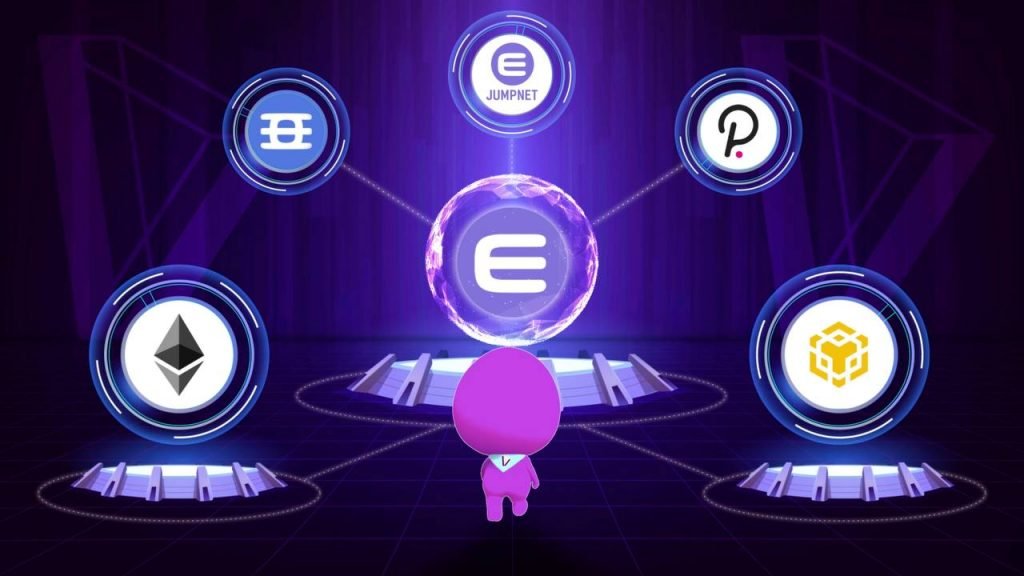
The Choice is Yours – Enjin (ENJ): Developers are excited to learn that Enjin supports the integration of an excellent selection of coins. The protocol supports Bitcoin, Ethereum, Binance Coin, Litecoin, Enjin Coin, and ERC-20, ERC-721, and ERC-1155 tokens. Developers can use Enjin to weave these coins seamlessly within their digital landscapes. Imagine a gamer’s delight when they stumble upon a Bitcoin while exploring. Now imagine the hype this windfall would bring to the game’s community. Along the same line of thought, Enjin streamlines the entire payment process. Rather than going through the red tape and delays of integrating fiat payment processes into games, developers can now charge for features using cryptocurrency. This strategy brings with it more efficiency and fewer fees. Game developers can reach a global audience and receive their payments in near real-time. In this way, Enjin eliminates the middleman and enables developers to provide more options.
-
Scalability: Scalability was a serious concern for Enjin’s development team. To be able to operate across huge gaming networks, the blockchain needed to be able to handle thousands of transactions per second. To accomplish this task, Enjin introduces a Proof-of-Stake mechanism that validates blocks every six seconds.
-
Enjin (ENJ) – NFTs: Enjin has taken a focus on the integration of Non-Fungible Tokens (NFTs) into the gaming sector. As part of this strategy, the network provides developers with tools to mint one-of-a-kind NFTs that can be authenticated on the blockchain. The group also formed an alliance with Ludena Protocol, the publisher of the social gaming platform GameTalkTalk recently. The goal of the partnership is to boost NFT awareness in South Korea.
-
Staking: ENJ stakers earn fees for helping to secure the network. These fees are derived from a percentage of the network fees, marketplace commissions, cross-chain bridging tolls, and smart contract fees. When you stake your ENJ you agree to leave it locked in a network smart contract for a preset time. You receive rewards in the form of cryptocurrency for your participation These rewards are based on the number of tokens you stake.
Disadvantages of Enjin
- If the price of ENJ falls too low, you could lose money by staking it.
- You need to have some technical knowledge to be able to stake ENJ.
- There is always the risk that the Enjin network could be hacked or attacked, which would lead to a loss of your staked ENJ.
- Overall, staking ENJ is a good way to earn extra income. However, you need to be aware of the risks involved before deciding to do it.
Use Cases of Enjin
Enjin’s main use case is to enable users to manage and store virtual goods for games.
These can range from in-game currencies to tokens representing unique game items like swords or accessories for characters.
To create and destroy in-game items, developers complete the following five steps:
- Acquisition – Developers buy ENJ
- Minting – Developers design in-game items using the purchased ENJ
- Gaming – Players acquire tokens and use them in-game for various functions
- Trading – Players trade tokens among each other
- Melting – Players sell tokens for ENJ.
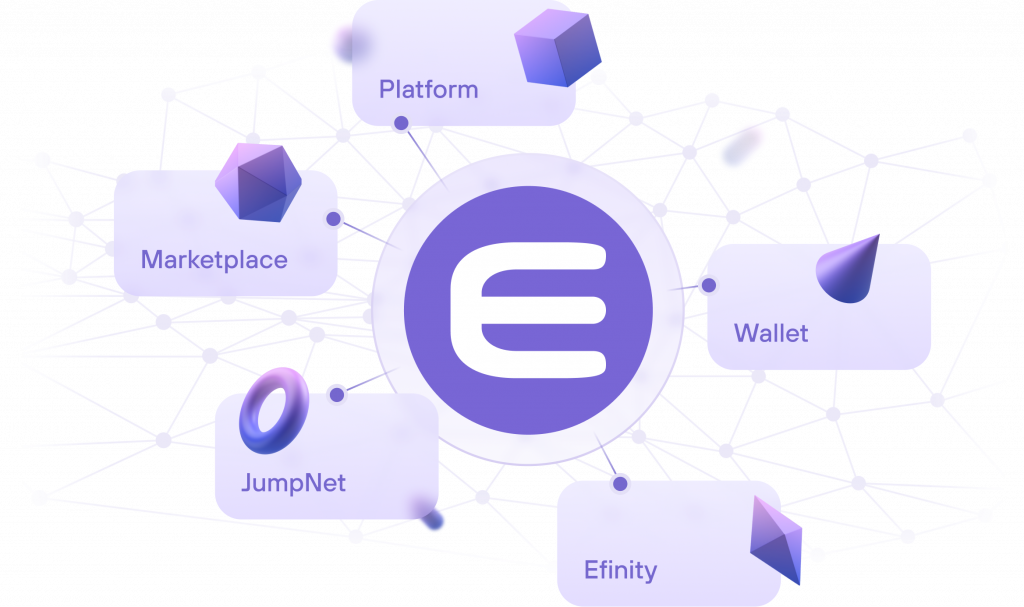
The Enjin team has built a variety of SDKs to enable these functionalities, which include kits focused on wallets and payment platforms. (These SDKs minimize the cost and complexity of creating virtual goods by offering common functionalities for creating these items.)
In conjunction with their SDKs, Enjin has also created application programming interfaces (APIs) to help deploy these items in the game.
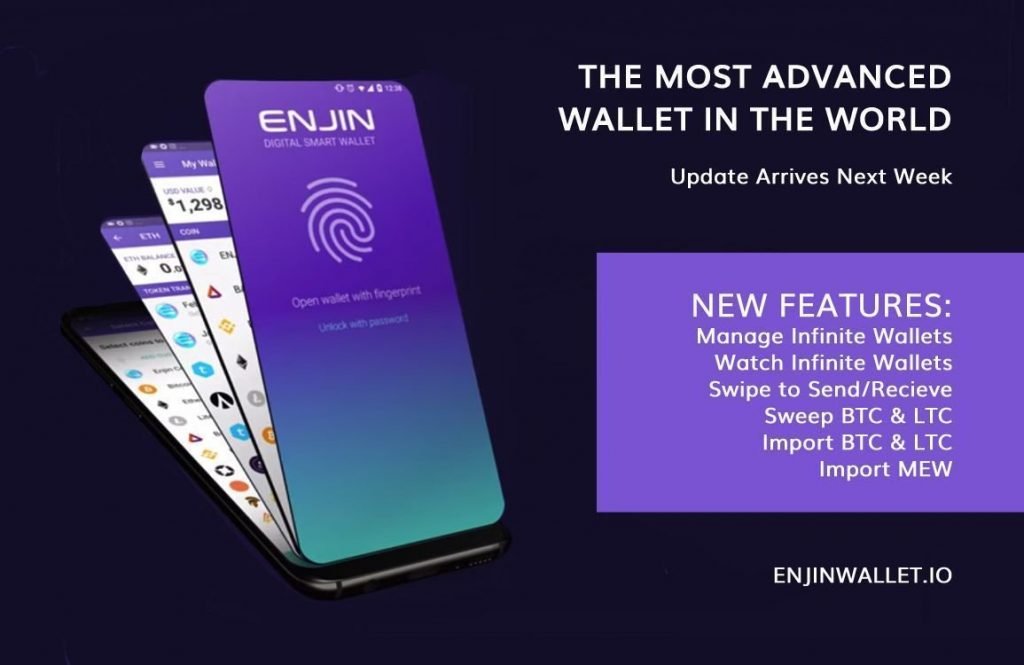
Enjin Smart Wallet
Enjin has its own native wallet where players can store and trade items, and that connects all of the platform’s features together.
The wallet allows users to:
- Assess their inventory, enabling them to connect to multiple games and use their items within each platform.
- Transact between themselves through the Enjin wallet, meaning that they can trade coins and items outside of the gaming environment.
- Sell their digital goods for ENJ.
Summary
ENJ enables developers to mint items for gaming environments on the Enjin platform. In order to mint virtual goods, developers have to lock ENJ into a smart contract, thus assigning a value to the item. When a player acquires these items, they can either use them in games, trade them to others or sell them for ENJ, in accordance with the original minting cost. Enjin may be of interest to any developer seeking to create new kinds of in-game assets, as they need to purchase ENJ to create assets on Enjin, investors may also find ENJ of interest should they want to gain exposure to a more transparent way to interact with digital goods for gaming.
Sources:
www.coingecko.com/en/coins/enjin-coin
coinmarketcap.com/currencies/enjin-coin/
en.cryptonomist.ch/2021/03/26/the-incredible-price-performance-of-enjin-coin/
www.coingecko.com/en/coins/enjin-coin
coinmarketcap.com/currencies/enjin-coin/
coinmarketcap.com/currencies/enjin-coin/
www.securities.io/investing-in-enjin-enj-everything-you-need-to-know/