
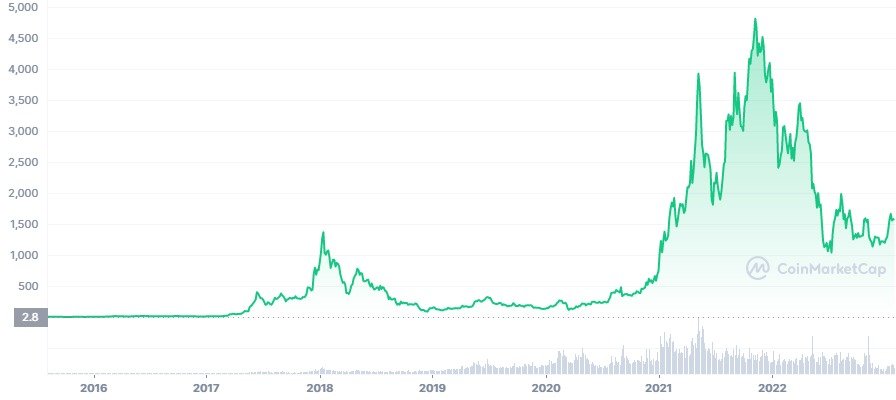
Ethereum Price Stats
-
Circulating Supply: 120,242,682
-
Supply Cap: Infinite
-
All-Time High: $4,878.26 -29.2% November 10, 2021
-
All-Time Low: $0.432979 797815.1% October 20, 2015
Brief History of Ethereum
Ethereum (ETH) is a decentralized open-source blockchain system that features its own cryptocurrency: Ether. ETH works as a platform for numerous other cryptocurrencies, as well as for the execution of decentralized smart contracts.
Ethereum was first described in a 2013 whitepaper by Vitalik Buterin. Buterin, along with other co-founders, secured funding for the project in an online public crowd sale in the summer of 2014. The project team managed to raise $18.3 million in Bitcoin. Ethereum’s price in the Initial Coin Offering (ICO) was $0.311, with over 60 million Ether sold. The Ethereum Foundation officially launched the blockchain on July 30, 2015, under the prototype codenamed “Frontier.” Since then, there have been several network updates — “Constantinople” on February 28, 2019, “Istanbul” on December 8, 2019, “Muir Glacier” on January 2, 2020, “Berlin” on April 14, 2021, August 5, 2021, the “London” hard fork, and most recently the “Merge” on September 15, 2022.
Ethereum’s own purported goal is to become a global platform for decentralized applications that allows users from all over the world to write and run software that is resistant to censorship, downtime, and fraud.
Given the fact that Ethereum is the second-largest cryptocurrency after Bitcoin, it is possible to buy Ethereum or use ETH trading pairs on nearly all of the major crypto exchanges. Some of the largest markets include Binance, Coinbase Pro, OKEx, Kraken, Huobi Global, and GEMINI.
To check Ethereum price live in the fiat currency of your choice, you can use CoinMarketCap’s converter feature directly on the Ethereum currency page. Alternatively, use the dedicated exchange rate converter page. Popular Ethereum price pairs include ETH/USD, ETH/GBP, ETH/AUD, and ETH/JPY.

The Team Behind Ethereum
Ethereum has a total of eight co-founders — a huge number for a crypto project. They first met on June 7, 2014, in Zug, Switzerland.
Russian-Canadian Vitalik Buterin is perhaps the best-known of the bunch. He authored the original white paper that first described Ethereum in 2013 and still works on improving the platform to this day. Prior to ETH, Buterin co-founded and wrote for the Bitcoin Magazine news website.
British programmer Gavin Wood is arguably the second most important co-founder of ETH, as he coded the first technical implementation of Ethereum in the C++ programming language, proposed Ethereum’s native programming language Solidity, and was the first chief technology officer of the Ethereum Foundation. Before Ethereum, Wood was a research scientist at Microsoft. Afterward, he moved on to establish the Web3 Foundation.
Among the other co-founders of Ethereum is – Anthony Di Iorio, who underwrote the project during its early stage of development. – Charles Hoskinson, played the principal role in establishing the Swiss-based Ethereum Foundation and its legal framework. – Mihai Alisie, who provided assistance in establishing the Ethereum Foundation. – Joseph Lubin, a Canadian entrepreneur, who, like Di Iorio, has helped fund Ethereum during its early days, and later founded an incubator for startups based on ETH called ConsenSys. – Amir Chetrit, who helped co-found Ethereum but stepped away from it early into the development.
Advantages of Ethereum
- Decentralization: The decentralized design of Ethereum effectively distributes knowledge and trust among network members, removing the need for a central authority to run the system and mediate transactions.
- Rapid deployment: Instead of building a blockchain implementation from scratch, organizations can quickly create and administer private blockchain networks using an all-in-one SaaS platform like Hyperledger Besu.
- Permissioned network: There are many open-source protocol layers that allow enterprises to build on public or private Ethereum networks, guaranteeing that their solution meets all regulatory and security standards.
- Network size: The Ethereum mainnet demonstrates that it is a network with millions of users. Most business blockchain competitors run networks with less than ten nodes and have no precedent for a large and successful network. For corporate collaborations that are bound to outgrow a few nodes, network scale is important.
- Finality: The consensus method of a blockchain ensures that the transaction record is tamper-proof and canonical. For different enterprise network instances, Ethereum offers customizable consensus mechanisms such as RAFT and IBFT, ensuring immediate transaction finality and reducing the required infrastructure that the Proof of Work algorithm requires.
- Tokenization: Any item that has been registered in a digital format can be tokenized on Ethereum. Organizations may fractionalize formerly monolithic assets (real estate), broaden their product line (provably rare art), and open new incentive models by tokenizing assets (crowdsourced data management).
- Interoperability and open source: On Ethereum, consortiums are not bound by a single vendor’s IT environment. Customers of Amazon Web Services, for example, can use Kaleido’s Blockchain Business Cloud to run private networks. The Ethereum ecosystem, like the Java community, encourages contributions to the codebase through Ethereum Improvement Proposals (EIPs).
- Pseudonymous transactions: In Ethereum, businesses may obtain privacy granularity by joining private partnerships with private transaction layers. Private information is encrypted and only shared with those who need to know.
- Scalability and performance: Consortium networks created on Ethereum may outperform the public mainnet and grow up to hundreds of transactions per second or more depending on network setup, thanks to Proof of Authority consensus and bespoke block time and gas limits.
- Standards: Ethereum is the place to be if you want to set the bar high. The ecosystem is kept from being fragmented through protocols for token design (ERC20), human-readable names (ENS), decentralized storage (Swarm), and decentralized communications (Whisper). The Client Specification 1.0 of the Corporate Ethereum Alliance outlines the architectural components for compatible enterprise blockchain implementations. The EEA intends to issue version 2.0 of the specification in the near future.
Disadvantages of Ethereum
- Uses a Complicated Programming Language: While Ethereum is Turing complete and uses a programming language similar to C++, Python, and Java, learning Solidity, the native language of Ethereum, may be challenging. One of the most significant concerns is the scarcity of beginner-friendly classes.
- Issues with Scaling: Unlike Bitcoin, which has a singular purpose, Ethereum has a ledger, a platform for smart contracts, and so on, all of which may lead to errors, malfunctions, and hacks.
- Ethereum Investing Can Be Risky: Ethereum investing, like any other cryptocurrency, can be risky. Cryptocurrencies are very volatile, resulting in significant gains as well as significant losses. The price of Ether has changed significantly in the past, which might be a disadvantage for certain investors, particularly newbies. In addition, Ethereum’s fees change, which is inconvenient. [taken from
Use Cases of Ethereum
Ethereum’s permissionless blockchain — which allows for the creation and development of applications without oversight from a central authority — creates a space for experimentation. There have been thousands of dApps built on Ethereum, millions of users, and many billions of dollars generated. Let’s take a look at some of the major use cases that have arisen on Ethereum so far.
Decentralized Autonomous Organizations: An early use case unearthed by Ethereum developers, decentralized autonomous organizations (DAOs) are blockchain-based organizations that operate without central authorities. They are governed by rules coded in software and administrative decisions are voted upon by a community of stakeholders. DAOs were one of the first innovations tested on Ethereum and remain influential today. While the hack of the pioneering Ethereum-based DAO in 2016 was a watershed moment in blockchain history, DAOs remain open-source and community-governed. Today, several DAOs, including MolochDAO and MetaCartel, operate in a similar fashion to the original DAO, pooling user funds to offer grants to Ethereum entrepreneurs.
Ethereum Token Launches: Initial Coin Offerings (ICOs) are token sales that function similarly to the traditional Initial Public Offering (IPO). Ethereum-enabled startup fundraising played a huge role in the growth of blockchain and crypto throughout 2017 and 2018. While Ethereum’s use of crowdfunding to bolster its protocol’s development in 2014 was novel, token launches exploded during what is known as the ICO boom. This increase in funding for crypto startups presented a paradigm shift in the way innovative startups raise funds.
ICOs garnered significant mainstream attention for Ethereum and the broader cryptocurrency space, but not all positive. Amidst the frenzy, some ICOs were not well conceived, a few were outright scams, while others were unable to achieve their goals — less than half of ICOs survived four months after their initial token sale. However, many projects that raised funds through an ICO are thriving — like prediction market company Augur and privacy-centric web browser Brave.
Displaying its ability to support the blockchain industry as a whole, Ethereum is the mechanism by which large blockchain projects launch and raise money. For example, EOSIO initially launched its token sale on Ethereum before migrating the tokens to its own blockchain. These token launches played a huge role in turning blockchain into a global phenomenon.
Enterprise Ethereum: Enterprise Ethereum refers to customized software and networks based on Ethereum that are created for private corporations and businesses. These networks are permission, meaning enterprise clients retain control over the architecture, the validators, and the users. The Enterprise Ethereum Alliance (EEA) now has more than 200 member organizations including Samsung Group, J.P. Morgan, Mastercard, and Microsoft — all of whom are experimenting with private versions of Ethereum for enterprise purposes. J.P. Morgan and more than 300 banks use a version of Enterprise Ethereum to run an inter-bank payment network. The Covantis initiative, set up by a group of institutions in the commodity industry, uses Enterprise Ethereum to run a post-trade execution platform for agricultural shipping transactions. And, Microsoft and Moët Hennessy Louis Vuitton (LVMH) adopted Enterprise Ethereum to build a tracking platform for luxury goods.
Non-Fungible Tokens on Ethereum: Non-fungible tokens (NFTs) are unique, indivisible, and provably scarce digital assets that are useful in gaming, art, and ensuring the provenance of luxury goods. The hype over NFTs began in late 2017 with the launch of CryptoKitties’ digital cat collectibles, but since then, the applications for the technology have grown rapidly. NFTs have attracted an increasingly mainstream audience to cryptocurrency and blockchain technology. The NBA, Ubisoft, and LVMH are experimenting with NFTs, as are other constituents.
Stablecoins: Stablecoins are cryptocurrency tokens pegged to another asset, typically a fiat currency. For example, there are stablecoins backed by fiat currencies like the U.S. dollar and commodities like gold, while other stablecoins maintain their value algorithmically. Additionally, some stablecoins are backed by a balanced basket of major cryptocurrencies. Stablecoins are used as a reliable store of value in the cryptocurrency ecosystem, a hedge against price volatility for crypto traders, and as a stable, global currency for people whose local fiat currency is devalued due to economic or political instability. Today, many crypto exchanges have their own stablecoins.
Decentralized Finance: Decentralized finance (DeFi) is the newest innovation to see an avalanche of use and growth on Ethereum. DeFi platforms are reinventing traditional financial products and services, adding programmable, decentralized, and censorship-resistant features to create brand-new financial products. For example, DeFi platforms offer peer-to-peer (P2P) borrowing and lending, interest on crypto holdings, decentralized exchange (DEX) mechanisms, stablecoins, and composable features that maximize passive earning opportunities. Popular DeFi platforms include Compound, MakerDAO, and Aave. In 2020, the total value locked in DeFi platforms eclipsed $4 billion.
A Breadth of Emerging Use Cases for Ethereum: There are myriad sectors in which Ethereum is providing utility and creating value. Industries from healthcare to entertainment to real estate are creating novel tools on the protocol to enhance efficiency, and trust, and democratize access to various types of services.
For example, Ethereum provides an ideal solution for managing royalties in the music industry by distributing tokens that represent ownership rights that facilitate the automated and seamless distribution of royalty payments. Ethereum projects working in the music industry include Ujo, Mediachain, and the Open Music Initiative.
In the massive global remittance industry, cross-border payments can be sent directly, quickly, and inexpensively by using a P2P protocol like Ethereum. For example, companies such as Everex, Abra, and BloomX use blockchain technology to cut out various intermediary banks that charge fees for currency exchange.
Ethereum’s tamper-proof blockchain-based ledger can assure supply chain and logistics managers about the provenance of products through verifiable blockchain-based cryptography. These businesses can track a product’s journey on the blockchain from the manufacturer to the checkout aisle, knowing that the data has not been tampered with. Meanwhile, end consumers can rest easy knowing that the products they purchase are in fact genuine. Everything from luxury goods to organic foods is tracked and traced with the Ethereum network.
Additionally, through the use of cryptographic methods, Ethereum ensures secure information sharing, which is essential for the transfer of sensitive data like medical records and identity information. Finally, Ethereum tokens democratize access to products that were once beyond the reach of many. There are Ethereum-based startups offering fractional ownership — owning a piece of a good, rather than the whole — of luxury goods and real estate, allowing consumers to diversify their investments. For instance, Meridio offers fractional ownership shares of real estate, and 55.com allows you to own a share of a high-value streetwear product, such as a Supreme hoodie.
Ethereum is the network of choice for innovation in the blockchain and cryptocurrency space. With its flexibility and robustness, new applications continue to emerge, and increased scalability in the future will continue to support development. From DAOs to Enterprise Ethereum to DeFi, the future of Ethereum looks more exciting than ever.
CZ (Changpeng Zhao, CEO of Binance) said, “Ethereum’s versatility and active ecosystem make it one of the most important projects in the cryptocurrency space. We fully support the development and growth of Ethereum and its potential to change industries.”
Summary
Ethereum is a blockchain-based all-in-one platform. The most popular question now is whether Ethereum is superior to other cryptocurrencies. Ethereum offers a significant benefit in that, in addition to investing in ether, one can also invest in firms that are developing apps that use the Ethereum network.
However, before making any large investment in Ether or other cryptocurrencies, talk to a financial counselor about the dangers involved. Even if you believe in Ethereum’s promise, be sure it’s money you can afford to lose, given the extreme risk and volatility in this market.
The Merge
The Merge was executed on September 15, 2022. This completed Ethereum’s transition to proof-of-stake consensus, officially deprecating proof-of-work and reducing energy consumption by ~99.95%. And while fears of bots and errors in the code during the merge were looming, eth has held up well post-merge and still maintaining a steady price action.
Sources:
https://coinmarketcap.com/currencies/ethereum/
www.gemini.com/cryptopedia/ethereum-smart-contracts-tokens-use-cases
https://www.thehindubusinessline.com/money-and-banking/cryptocurrency/bl-explainer-why-was-ethereum-merge-an-important-day-for-crypto-industry/article65898576.ece
www.analyticssteps.com/blogs/advantages-and-disadvantages-ethereum